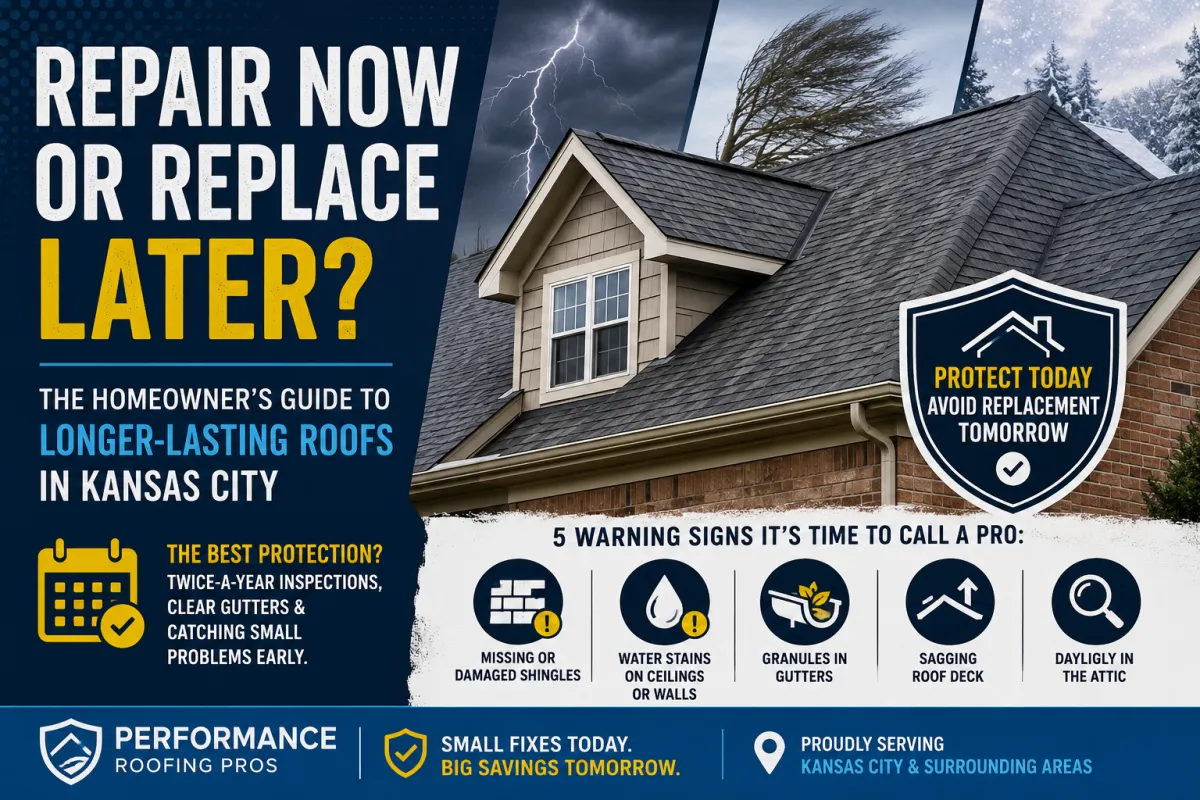
How to Protect Your Roof (and Your Wallet): A Kansas City Homeowner's Guide
Quick answer: The single biggest thing that keeps a roof repair from turning into a roof replacement is catching small problems early — twice-a-year inspections, keeping gutters clear, and knowing the five warning signs that mean it's time to call a professional instead of waiting. Kansas City's mix of hailstorms, high wind, and freeze-thaw winters is harder on roofs than most of the country, which makes this routine even more important here than in milder climates.
Your roof is the single most expensive system on your house to replace — and the cheapest to maintain, if you catch problems while they're still small. Most of the roofs we replace didn't fail overnight. They failed because a small, fixable issue went unnoticed for a year or two and turned into water damage, rot, or a full tear-off.
Here's what actually protects a roof, what a leak really costs if you wait, and how to tell the difference between "keep an eye on it" and "call someone now."
Why Kansas City Roofs Take More Abuse Than Most
Homeowners in Liberty, Gladstone, Parkville, Overland Park, Olathe, Lenexa, and Gardner are all dealing with the same regional stress test: hail season in spring, straight-line winds in summer, and freeze-thaw cycles all winter that force water into any crack that's already there. That combination is exactly why local, seasonal maintenance matters more here than in a climate that only deals with one or two of those stressors.
The 4-Step Seasonal Roof Inspection
You don't need to get on the roof yourself to do most of this — a pair of binoculars and 15 minutes twice a year (spring and fall) covers it.
1. Scan the shingles from the ground. Look for shingles that are curling, cracked, missing, or covered in granule loss (bald-looking patches where the shingle looks smoother or darker than the rest). Granules in your gutters or downspout runoff are an early warning sign, not just cosmetic wear.
2. Check the flashing. Flashing is the metal sealing the joints around your chimney, vents, and skylights. It's the single most common place a roof actually starts leaking — not the shingles themselves. Look for rust, gaps, or lifted edges.
3. Clear and inspect the gutters. Clogged gutters send water back up under your shingles instead of off the roof, which is one of the most preventable causes of rot and interior water damage. Clean them out at least twice a year, more often if you're under trees.
4. Look inside, too. Head up to the attic with a flashlight after a hard rain. Water stains, damp insulation, or daylight coming through the roof deck are signs of a leak that hasn't shown up on your ceiling yet — which means you're catching it before it becomes a bigger repair.
5 Signs You Need a Professional — Not a Weekend Fix
A little maintenance goes a long way, but some signs mean it's time to stop DIY-ing and get a trained eye on the roof before it gets worse.
Granules piling up in your gutters or at downspout exits. This means shingles are wearing down faster than they should be.
Daylight visible through the roof boards in your attic. This is an active gap, not a future problem — it needs attention now.
Sagging anywhere on the roofline. Sagging usually means the roof deck underneath has already taken on moisture damage.
Shingles that are curling, cracked, or missing after a storm. Storm damage isn't always obvious from the ground, and hail damage in particular can be invisible until it fails months later.
A roof that's 15–20+ years old and hasn't had a professional inspection. Even a roof that looks fine from the curb can be past the point where patch repairs make financial sense.
If you're seeing any of these, the smart move is a professional roof inspection — not because every issue means you need a new roof, but because a trained inspector can tell you whether you're looking at a $400 repair or a $12,000 one, and catching that early is what keeps it the smaller number.
Why "Wait and See" Is the Most Expensive Roofing Strategy
A small roof leak rarely stays small. Water that gets past your shingles doesn't just sit there — it travels along the roof deck, soaks insulation, and can quietly rot framing for months before it shows up as a stain on your ceiling. By the time you see a leak indoors, the damage usually isn't limited to the roof anymore.
That's the real cost of delay: what could have been a localized repair becomes a job that also involves drywall, insulation, and sometimes structural repair. Catching problems at the twice-a-year inspection stage is almost always the cheaper path.
Frequently Asked Questions
How often should I get my roof inspected? Twice a year — once in spring after winter freeze-thaw cycles and hail season, and once in fall before winter sets in. You should also schedule an inspection after any major hailstorm or high-wind event, even if you don't see obvious damage from the ground.
How much does a roof repair typically cost vs. a full replacement? Minor repairs (flashing, a handful of shingles, minor leak sealing) are usually a few hundred dollars. Once water damage reaches the roof deck or interior framing, costs climb quickly — which is why early detection matters more than the repair itself.
Can I inspect my own roof, or do I need a professional? You can and should do the ground-level and attic checks yourself twice a year. But if you spot any warning signs — sagging, granule loss, storm damage, or a roof over 15 years old — bring in a professional. Some damage, especially hail damage, isn't visible to an untrained eye even up close.
Does homeowners insurance cover roof damage? Storm and hail damage are often covered, but coverage depends on your policy, your roof's age, and how quickly it's reported. A professional inspection after a storm gives you documentation that makes the insurance claims process easier.
What's the average lifespan of a roof in the Kansas City area? Asphalt shingle roofs typically last 20–25 years nationally, but Kansas City's hail and freeze-thaw cycles tend to shorten that. Regular inspection and maintenance is what closes the gap between average lifespan and actual lifespan.
The Bottom Line
Roof problems are cheap when they're small and expensive when they're ignored. A twice-a-year look from the ground and the attic, clean gutters, and a fast call to a professional when something looks off is the entire strategy — no special tools required.
If it's been a while since your roof had a professional look-over, or you noticed any of the warning signs above, Performance Restoration offers roof inspections for homeowners throughout the Kansas City metro, including Liberty, Gladstone, Parkville, Overland Park, Olathe, Lenexa, Shawnee, Raytown, Paola, and Gardner. Catching it now is almost always cheaper than waiting.
